


There’s a kind of exhaustion that’s harder to name than the physical kind.
It’s not the tiredness that comes from a 2am medication run. It’s not even the weight of a hard conversation or a bad day at the hospital. It’s the particular heaviness of guilt. The slow, persistent kind that sits with you in the quiet moments. In the car. In the shower. Right before you fall asleep.
I should be doing more.
I shouldn’t feel this way.
A good daughter/son wouldn’t resent this.
As a caregiver, you know exactly what I’m describing. And here’s the part nobody says out loud: guilt is one of the sneakiest threats to your self-care there is. Not because it hurts. Because it pretends to be helping. It masquerades as virtue. It sits there in the corner of your mind looking responsible, and all the while it is draining you.
As Catholics, this is especially familiar territory. We understand that a well-formed conscience matters, that guilt, properly understood, is a gift from God. A healthy guilt, properly understood, really is a gift because it draws you back to God and keeps your soul honest. A signal from your interior life that something needs attention. The Catechism teaches that a properly formed conscience can distinguish true guilt, the kind that calls us toward repentance and change, from false guilt, which leads only to unnecessary distress and spiritual paralysis.
But here’s where it gets complicated for caregivers.
Not everything that feels like guilt is guilt. And learning to tell the difference is, quite literally, an act of self-care.
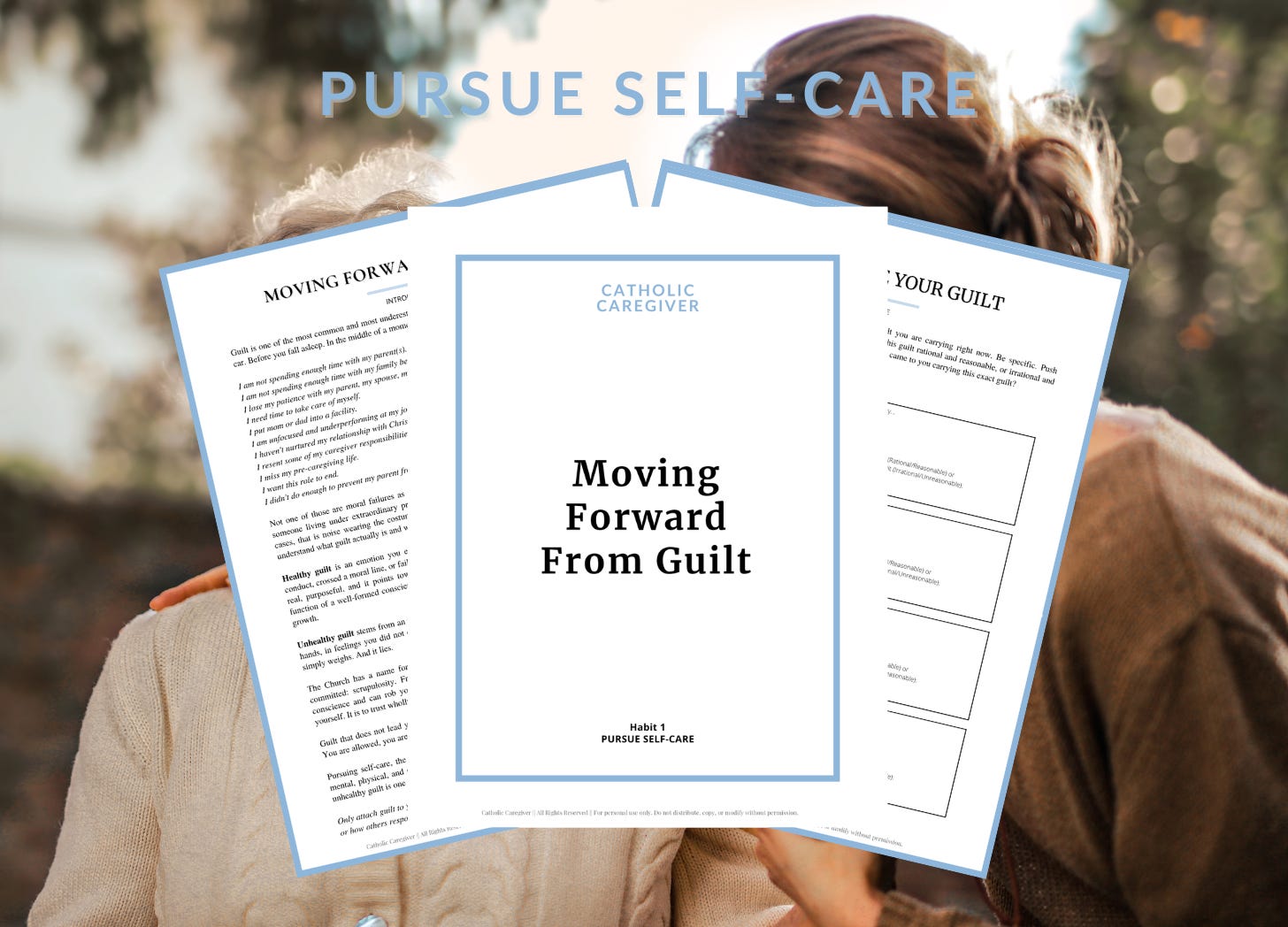
Pursue Self-Care: Why Guilt Belongs Here
Pursue Self-Care is the first and most foundational habit of the Successful Caregiver Approach. It is the habit that makes everything else possible. If your emotional, mental, physical, and spiritual well-being erodes, so does your ability to care well. You cannot pour from an empty vessel. And unexamined guilt is one of the most consistent ways caregivers quietly empty themselves.
Guilt that goes unaddressed doesn’t just feel bad. It makes you reluctant to rest, because rest feels selfish. It makes you reluctant to ask for help, because asking feels like failure. It keeps you running at a deficit. And over time, that deficit shows up in your patience, your relationships, your body, and your faith.
So we’re going to look at it directly. And we’re going to give you a framework that actually works.
The Guilt Caregivers Carry
Let’s start with the list. Not a theoretical list. A real one. These are the guilt statements caregivers carry most often:
I am not spending enough time with my parent(s).
I am not spending enough time with my family because I am always with my parent(s).
I lose my patience with my parent, my spouse, my family, my coworkers.
I need time to take care of myself.
I put mom or dad into a facility.
I am unfocused and underperforming at my job.
I haven’t nurtured my relationship with Christ. I am spiritually depleted.
I resent some of my caregiver responsibilities.
I miss my pre-caregiving life.
I want this role to end.
I didn’t do enough to prevent my parent from experiencing this.
Look at that list. Really look at it.
Not one of those are moral failures as stated. Almost all of them are the completely human experience of a person living under extraordinary pressure. A person who loves her parent deeply enough to be wrecked by the gap between what she wishes she could give and what is humanly possible.
That’s not a bad conscience calling you to account. In most cases, that is noise wearing the costume of virtue. And it has to go.
Two Types of Guilt Every Caregiver Needs to Know
Healthy guilt is an emotion you experience when you believe you have genuinely broken a standard of conduct, crossed a moral line, or failed to live up to a value. It stems from a rational and reasonable cause. It is real, purposeful, and it points toward something actionable. The Catholic tradition sees this as a healthy function of a well-formed conscience. One that, when responded to rightly, leads to repentance, healing, and growth.
Unhealthy guilt stems from an irrational and unreasonable cause. It surfaces in situations that are out of your hands, in decisions made under impossible circumstances, in feelings you didn’t choose to have. Instead of pointing you toward something you can change, it simply weighs. It paralyzes. And it lies.
The Church has a name for the soul that cannot stop feeling guilty even when no real wrong has been committed: scrupulosity. From a Catholic view, it’s not holiness, it’s a form of anxiety that distorts conscience and can rob your peace. Saints like Ignatius of Loyola and Thérèse of Lisieux wrestled with it. Spiritual directors have counseled it for centuries, not because it signals devotion, but because it is a distorted conscience that condemns where there is nothing to condemn. St. Alphonsus Liguori taught that true humility is not to think ill of yourself. It is to trust wholly in God.
Guilt that does not lead you toward God, toward change, or toward healing is not your conscience speaking. You are allowed, you are invited, to put it down.
✦ Paid Subscribers, below you’ll find: the two-question framework for sorting healthy from unhealthy guilt, two real caregiving scenarios showing exactly what that looks like in practice, the Wisdom to Carry, the exercise walkthrough, and your free PDF download of the complete Moving Forward From Guilt guide.
The Two Questions That Change Everything
Here’s the framework. Two questions. Every time guilt surfaces, run it through both.
